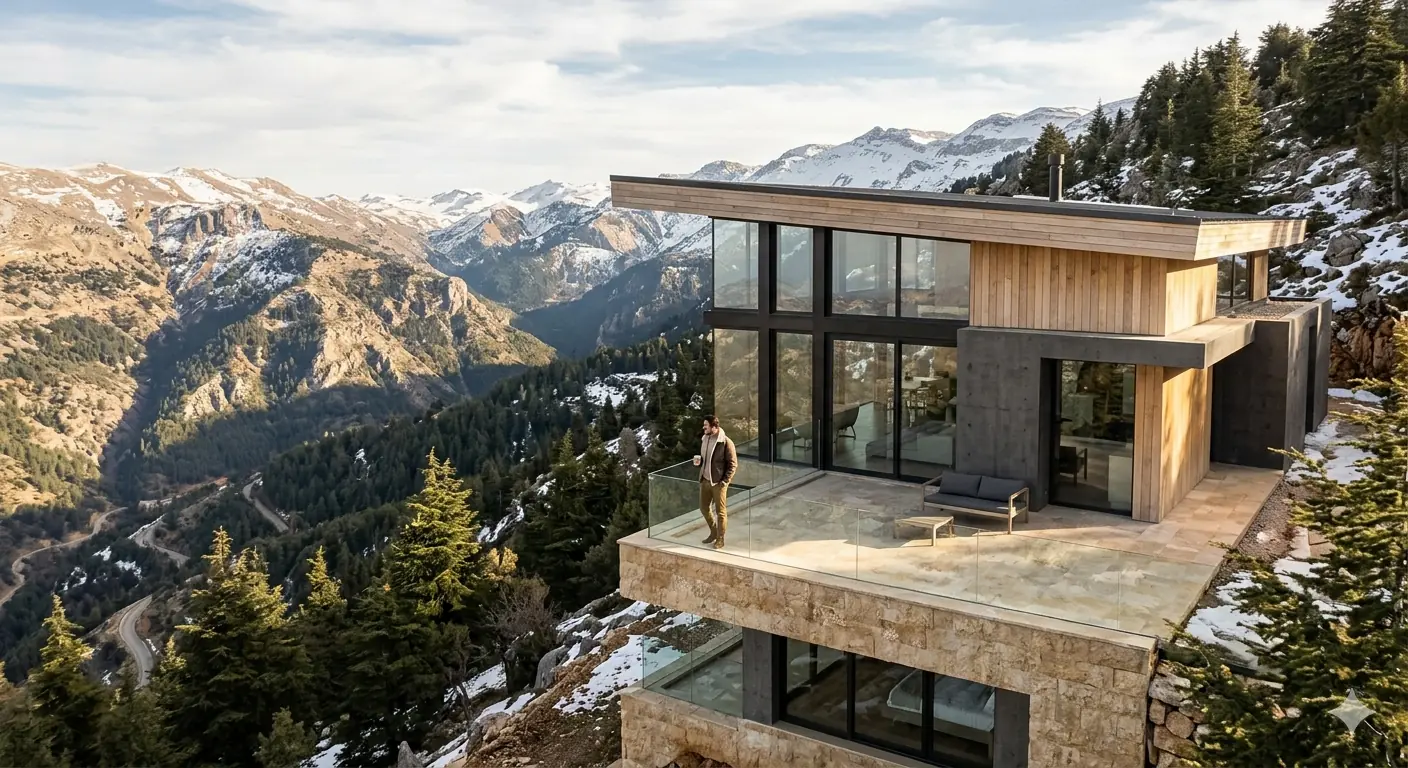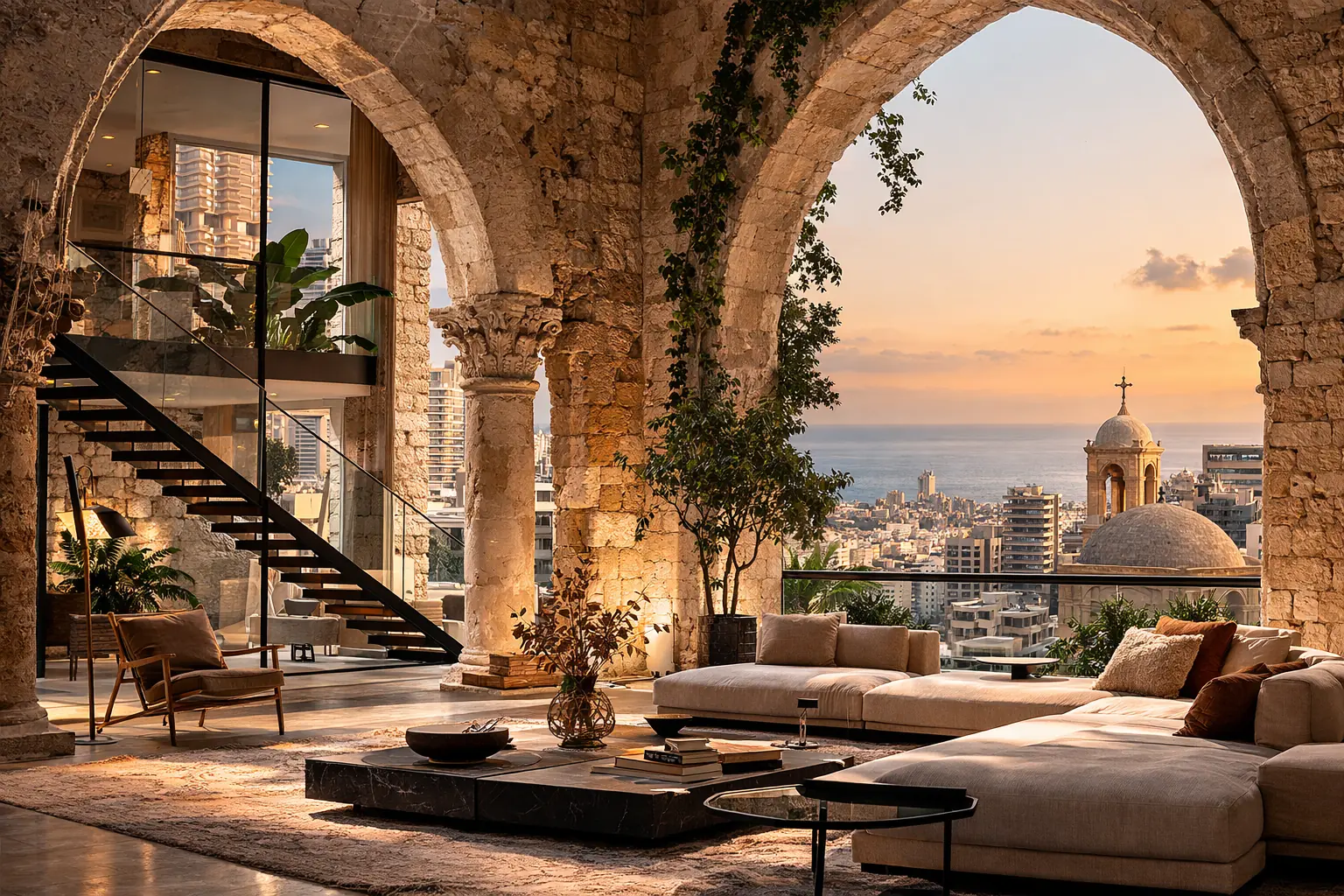
There's a moment in almost every Lebanese residential project where the conversation comes down to materials. Clients bring reference images from around the world — Scandinavian timber, Japanese minimalism, Tuscan warmth. But nine times out of ten, the project finds its way back to the same two materials: natural stone and exposed concrete. It's not a lack of imagination. It's that this pairing works here in a way it doesn't quite work anywhere else.
Lebanon sits on a geological gift. The country's limestone deposits are vast, varied, and stunning — ranging from warm honey tones in the coastal hills to cool silver-grey in the high mountains. This stone has been quarried for millennia. Roman temples, Crusader castles, Ottoman mansions — they were all built from it. When a Lebanese architect reaches for local stone, they're connecting to an unbroken material tradition thousands of years deep.
The conversation between warm and cool
What makes stone-and-concrete work so well is the dialogue between the two. Stone is warm, textured, organic, and irregular. Concrete is cool, smooth, precise, and industrial. Placed next to each other, each material elevates the other. The concrete reads as sharper and more sophisticated against the stone's natural roughness. The stone feels warmer and more alive against the concrete's controlled geometry.
This isn't just aesthetic theory — it's something you feel physically when you walk through a home that uses both materials thoughtfully. A rough-cut limestone accent wall in a living room with polished concrete floors creates a sensory richness that neither material achieves alone. Your eye moves between textures. Your hand wants to touch both surfaces. The space has weight and presence without being heavy.
Climate as collaborator
The practical advantages are just as compelling. Both stone and concrete have high thermal mass, meaning they absorb heat during the day and release it slowly at night. In Lebanon's Mediterranean climate — hot summers, cool winters, and dramatic daily temperature swings — this is an enormous advantage. Homes that use these materials intelligently require less mechanical heating and cooling, a significant consideration in a country where electricity supply has been unreliable for years.
When you build with stone and concrete in Lebanon, you're not just making an aesthetic choice — you're making a climate choice. These materials breathe with the seasons the way steel and glass never will.
There's also the durability factor. Lebanon's coastal air carries salt and moisture that eats through lesser materials. Steel rusts. Timber rots. But stone and concrete — properly specified and detailed — endure for generations. In a country where building a home represents a family's single largest investment, often across generations, longevity isn't a luxury. It's a requirement.
Beyond the expected
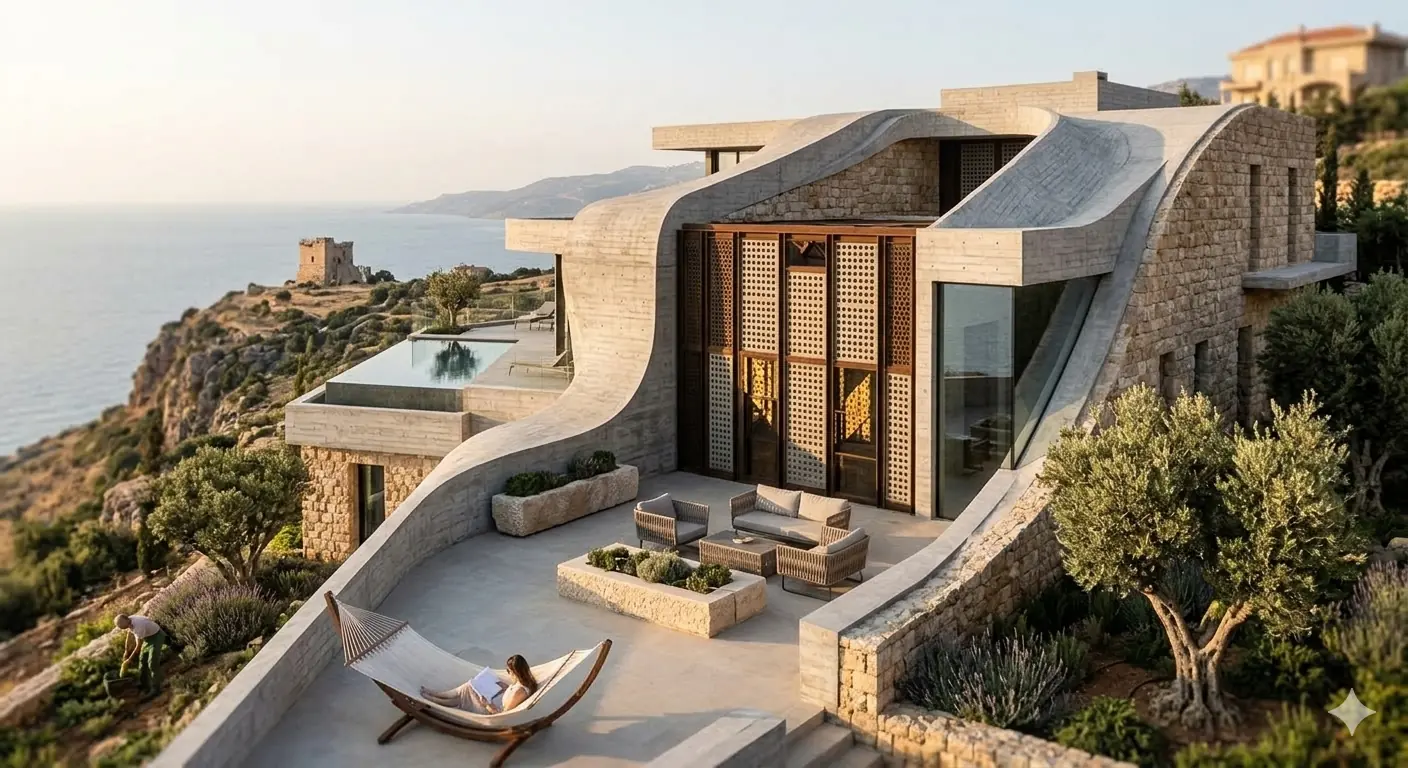
The most exciting work being done with this material pairing today pushes beyond the obvious. Architects are experimenting with board-formed concrete that carries the grain pattern of the timber formwork, creating a third texture that bridges the organic and the industrial. Stone is being used not just as cladding but as structural walls, load-bearing in a way that gives interiors a cave-like solidity and silence. Concrete is being pigmented with local earth tones, blurring the line between the two materials.
There's also a growing interest in the joint between materials — the detail where stone meets concrete. This seam, when handled clumsily, can undermine both materials. But when handled with care — a shadow gap, a brass reveal, a deliberate offset — it becomes a design feature in its own right. The best Lebanese residential architecture right now is obsessing over these transitions, and it shows.
A material language that belongs
At its core, the enduring appeal of stone and concrete in Lebanese architecture comes down to belonging. These materials don't need to be explained or justified in this context. They're native — geologically, culturally, and climatically. A home built with local limestone and carefully detailed concrete doesn't look like it's trying to be somewhere else. It looks like it grew from the site.
That sense of rootedness is increasingly rare in global architecture, and increasingly valuable. As the world moves toward more sustainable, locally sourced building practices, Lebanon's stone-and-concrete tradition turns out to be ahead of the curve. What started as a practical choice dictated by available materials has evolved into a sophisticated design language — one that's uniquely Lebanese and universally admired.
At Alain Azar Architect, stone and concrete are in our DNA. Every project begins with a visit to the quarry and a conversation about aggregate. It's not glamorous work, but it's where the soul of a building is found — in the material it's made of, and the land it came from.